







EE-402 CONTROL ENGINEERING
CREDIT HOURS
Theory = 2
Practical = 0
COURSE LEARNING OUTCOMES (CLOs)
| S. No. | CLOs | PLO | Taxonomy |
| 1 | Analyze the behavior and stability of control systems by applying time and frequency response analysis, Laplace transforms, Mason's gain formula. | PLO-2 Problem Analysis |
Cognitive Level 4* |
| 2 | Design PID controllers and compensators using root-locus and frequency-domain techniques to meet specified system performance and stability criteria. | PLO-3 Design/Development of Solutions |
Cognitive Level 5* |
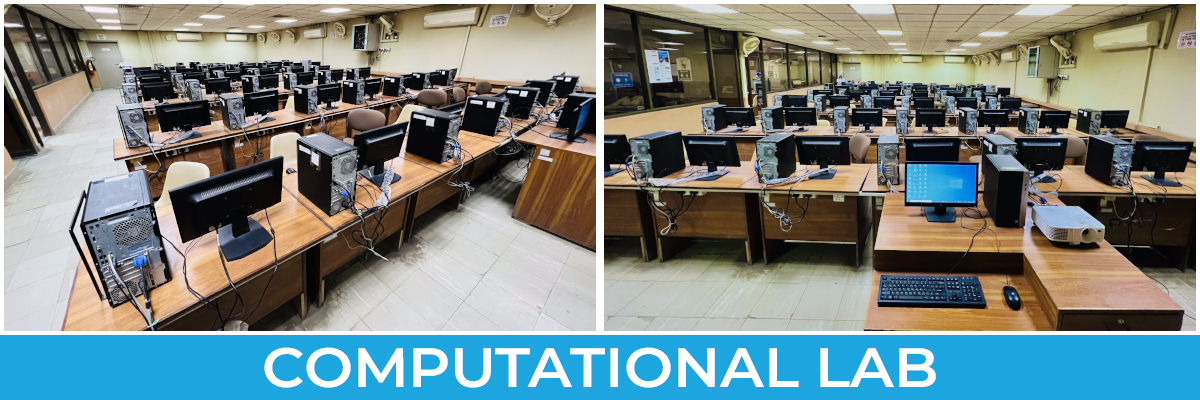
| 3 | Simulate control system models using software tools to represent block diagrams, signals flow graphs, and state-space systems, and evaluate system performance for various input types and configurations. | PLO-5 Tool Usage |
Cognitive Level 3* |
COURSE CONTENT
- Introduction: Basics of control systems, open-loop and closed-loop control systems, block diagram terminology, examples of systems for block diagrams, signal flow graphs.
- Dynamic System Modeling: Mechanical translational and rotational systems, electrical active and passive systems, electromechanical systems, conversion of electrical systems to equivalent mechanical systems and vice versa, thermal systems, and fluid systems.
- Laplace Transforms and Transfer Function: Mason gain formula to find transfer function, Mason’s formula application for electrical and mechanical systems, development of nodal equations from signal flow graphs, development of signal flow graphs from nodal equations.
- State Space Formulation: State space formulation from differential equations, state space formulation from block diagrams and signal flow graphs, control and observer canonical forms of block diagrams and state space, types of inputs like impulse, step, ramp, and sinusoidal input, solution of state space for different responses, system linearization and its applications.
- Time Response of 1st and 2nd Order Systems: Time response of 1st and 2nd order systems (impulse, step, ramp, etc.), time response characteristics, frequency response of 1st and 2nd order systems, time response of higher-order systems.
- Study of System Stability: Introduction to stability, poles and zeros concept, Routh-Hurwitz stability criteria and its applications, concept of root-locus.
- Root Locus Design: Root locus design, system stability by pole placement, compensator design (lead and lag compensator), design of PID controller (P, PI, and PID controllers), different PID controller tuning methods.
- Frequency Design: Introduction to frequency plots, Bode plots, system stability using Bode plots.
RECOMMENDED BOOKS
Text Book(s)
- Phillips, C. L., Harbor, R. D., Feedback Control Systems, Prentice-Hall.
- Ogata, K., Modern Control Engineering, Prentice-Hall.
- Nise, N. S., Modern Control Engineering, John Wiley & Sons.
Reference Book(s)
*For details of Taxonomy Levels CLICK HERE